



Quickly Understand the Platform Laser Welding Machine
A platform laser welding machine is an industrial welding system designed to provide precise, stable, and efficient welding for metal components. By combining laser technology with a work platform, positioning mechanisms, and an integrated control system, this equipment enables manufacturers to complete welding tasks with high accuracy and repeatability. It is widely used in sheet metal fabrication, automotive components, hardware manufacturing, electronics, and precision metalworking.
As manufacturers seek higher productivity and better welding quality, platform laser welding machines have become an attractive solution for applications that require consistent weld seams, reduced thermal distortion, and efficient production workflows.
Understanding how a platform laser welding machine works, what advantages it offers, and how to select the right configuration can help businesses make informed purchasing decisions. In this guide, we explore the essential features, applications, benefits, and selection criteria of platform laser welding machines.
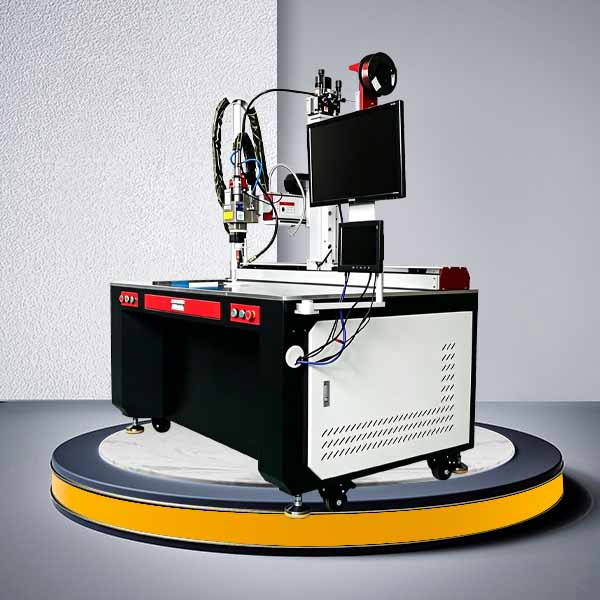
What Is a Platform Laser Welding Machine?
A platform laser welding machine is a laser welding system that uses a dedicated worktable or platform to support and position workpieces during welding. Depending on the machine design, the platform may be fixed, manually adjustable, motorized, or integrated with a CNC-controlled movement system.
The machine directs concentrated laser energy onto the joint between two metal components. The laser rapidly heats the material, causing the joint area to melt and form a weld as the material cools and solidifies.
Compared with conventional welding processes, laser welding can deliver concentrated heat input, narrow weld seams, and high processing speeds. These characteristics make it suitable for applications where dimensional accuracy and a clean finish are important.
Platform laser welding machines are available in different configurations, including manual systems, semi-automatic equipment, and automated welding platforms. Some models use fiber lasers, while others may employ different laser sources depending on the materials and production requirements.
How Does a Platform Laser Welding Machine Work?
A platform laser welding machine typically consists of a laser source, optical delivery system, welding head, work platform, motion system, control unit, and cooling system.
The welding process generally follows several steps.
1. Workpiece Positioning
The operator places the metal components on the work platform and aligns the welding joints. Fixtures or clamping devices can hold the parts in the correct position to minimize movement during welding.
Accurate positioning is essential for maintaining consistent weld quality, especially when working with thin sheet metal or small precision components.
2. Laser Energy Generation
The laser source generates a concentrated beam of light. In many industrial systems, a fiber laser is used because of its high efficiency, stable output, and suitability for metal processing.
The laser beam is delivered to the welding head through an optical fiber or another appropriate optical arrangement.
3. Focused Laser Welding
The welding head focuses the laser energy onto the joint. The concentrated energy heats and melts the material locally, creating a molten pool that joins the components.
Depending on the laser parameters, material thickness, and joint design, the process may operate in conduction or keyhole welding mode.
4. Platform Movement and Process Control
On systems with motorized or CNC-controlled platforms, the workpiece or welding head moves along a programmed path. This helps maintain consistent welding speed and positioning.
The control system manages parameters such as laser power, welding speed, and other process settings supported by the machine.
5. Cooling and Weld Inspection
After the laser passes over the joint, the molten material solidifies to form the weld. The finished joint can then be inspected for penetration, surface appearance, dimensional accuracy, and other application-specific quality requirements.
Proper parameter selection and suitable shielding gas, where required, help improve welding consistency.
Key Advantages of a Platform Laser Welding Machine
Platform laser welding machines offer several benefits for industrial manufacturers, although actual performance depends on the equipment configuration, material, and welding process.
High Welding Precision
Laser energy can be concentrated into a small area, allowing precise control over the weld location. This is particularly useful for small components, narrow seams, and products with strict dimensional tolerances.
A stable platform and accurate positioning system further improve repeatability by reducing workpiece movement during processing.
Reduced Thermal Distortion
Laser welding typically introduces heat into a more localized area than many conventional welding processes. This can reduce the heat-affected zone and minimize distortion in suitable applications.
For thin sheet metal and precision components, reduced thermal distortion can help preserve product dimensions and surface appearance.
Improved Production Efficiency
Laser welding can achieve high welding speeds on suitable materials and joint geometries. Platform-based systems also simplify workpiece positioning and can reduce the time required for repeated operations.
When combined with fixtures and programmed motion, the machine can support consistent production cycles and reduce repetitive manual work.
Consistent Welding Quality
A well-configured laser welding system can maintain stable welding parameters across repeated production runs. Programmable controls and accurate positioning help reduce variations between parts.
However, consistent results still require suitable joint preparation, appropriate fixtures, process monitoring, and routine equipment maintenance.
Clean Weld Appearance
Laser welding can produce narrow, visually clean welds with relatively little spatter under appropriate conditions. This may reduce grinding, polishing, and other finishing operations.
The need for post-weld treatment depends on the material, joint design, quality requirements, and selected welding parameters.
Common Applications of Platform Laser Welding Machines
Platform laser welding machines are used across industries that require accurate joining, repeatable processing, and efficient metal fabrication.
Sheet Metal Fabrication
Manufacturers use platform laser welding machines to join sheet metal enclosures, cabinets, brackets, panels, and other fabricated components.
The localized heat input can be beneficial when working with thin metal sheets that are susceptible to distortion.
Automotive Parts Manufacturing
Automotive suppliers may use platform laser welding systems to manufacture metal brackets, housings, structural components, and other assemblies.
For high-volume applications, fixtures and automated movement can help maintain repeatable weld positions and production quality.
Hardware and Metal Products
Hardware manufacturers can use platform laser welding machines to weld metal fittings, frames, handles, metal containers, and various custom products.
The platform supports stable positioning and can accommodate different fixtures for different product designs.
Electronics and Electrical Components
Certain metal housings, connectors, terminals, and electrical component assemblies require precise joining with limited thermal impact on surrounding parts.
Laser welding may be suitable for these applications when the materials, component design, and heat sensitivity have been carefully evaluated.
Medical and Precision Components
Some precision metal components and compatible medical-device assemblies require controlled welding and accurate joint formation.
For these applications, manufacturers should evaluate material compatibility, cleanliness requirements, process validation, and applicable industry standards before selecting the equipment.
Which Materials Can a Platform Laser Welding Machine Weld?
The materials that a platform laser welding machine can process depend on the laser source, available power, optical configuration, and process parameters.
Common materials include:
Stainless steel: Frequently used in enclosures, equipment housings, kitchenware, and precision metal products.
Carbon steel: Common in industrial fabrication, brackets, frames, and mechanical components.
Aluminum and aluminum alloys: Used in lightweight structures, electrical housings, and transportation components.
Copper and copper alloys: Used in selected electrical and thermal-management applications, although their high reflectivity and thermal conductivity require careful process selection.
Titanium and selected alloys: Used in specialized industrial, aerospace, and precision applications where suitable process control is available.
Different materials absorb laser energy differently and have different thermal properties. Aluminum, copper, and highly reflective metals may require specialized parameter settings and appropriate equipment safeguards.
Before purchasing a machine, we should confirm that it can weld the intended material grades and thicknesses while meeting the required joint-strength and appearance standards.
Platform Laser Welding Machine vs. Traditional Welding Equipment
Selecting between laser welding and conventional welding depends on production requirements, budget, materials, and joint design.
Comparison factor | Platform laser welding machine | Traditional welding equipment |
|---|---|---|
Heat input | Concentrated in the weld area | Depends on the welding process |
Welding speed | High in suitable applications | Varies by process and joint |
Precision | Well suited to precise, narrow seams | Depends on equipment and operator skill |
Thermal distortion | Often lower under suitable conditions | Can be higher in heat-sensitive parts |
Automation | Compatible with programmed motion and fixtures | Also automatable, depending on process |
Initial investment | Can be relatively high | Varies widely |
Operator requirements | Requires laser-specific training and safeguards | Requires process-specific training |
Best application | Precision, repeatability, and suitable production volumes | Broad range of fabrication and repair tasks |
Laser welding is not automatically the best solution for every job. Conventional MIG, TIG, and other welding processes may be more economical for certain thick materials, field repairs, or applications where joint preparation and accessibility favor traditional methods.
How to Choose the Right Platform Laser Welding Machine
Choosing the right equipment requires matching its specifications to the actual production task rather than selecting a machine based on laser power alone.
1. Determine the Required Laser Power
Laser power influences welding capability, but the required output depends on material type, thickness, joint configuration, welding speed, and penetration requirements.
Higher power may be necessary for thicker components or higher production speeds. Thin materials may require lower power and more precise control to avoid burn-through or excessive distortion.
We should ask the supplier to verify performance using representative workpieces.
2. Evaluate the Platform Size
The working platform must accommodate the largest components, fixtures, and required movement range.
A platform that is too small limits the range of products that can be processed. An unnecessarily large platform may increase equipment costs and occupy valuable factory space.
We should also consider workpiece weight, loading access, clamping arrangements, and whether the platform supports the required positioning accuracy.
3. Check the Motion and Positioning System
Manual platforms may be sufficient for simple welding tasks and low-volume production. Motorized or CNC-controlled platforms are more appropriate when welding paths must be repeated accurately.
For complex parts or high-volume production, we should assess motion accuracy, repeatability, programming capabilities, and compatibility with existing manufacturing processes.
4. Compare Laser Sources and Welding Heads
Fiber lasers are widely used in industrial metal welding because of their efficiency and compatibility with many metal-processing applications.
When evaluating the laser source and welding head, we should consider output stability, supported materials, maintenance requirements, available process controls, and service support.
Some systems include oscillating or wobble welding heads, which move the beam in a controlled pattern to accommodate certain joint conditions or improve weld formation.
5. Review Cooling and Safety Systems
Industrial laser welding machines may require water cooling or another specified cooling arrangement to maintain stable operation.
We should verify cooling capacity, environmental requirements, and maintenance procedures. Laser safety is equally important. The installation must provide appropriate protection against direct and reflected laser radiation, with suitable guarding, interlocks, protective equipment, and operator training according to the laser class and applicable regulations.
6. Consider Automation and Future Expansion
If production volumes are expected to grow, it may be worth considering programmable controls, automatic loading, robotic integration, or additional positioning axes.
The right configuration should balance present requirements with realistic future production needs.
Essential Maintenance Tips for Platform Laser Welding Machines
Regular maintenance helps preserve welding performance, equipment reliability, and workplace safety.
Keep optical components clean. Follow the manufacturer's procedures for inspecting and maintaining protective windows and other optical components. Contamination can reduce performance and damage expensive parts.
Inspect the cooling system. Maintain the specified coolant quality, flow, and temperature. Check for leaks and follow the recommended maintenance schedule.
Check fixtures and platform alignment. Loose clamps, worn fixtures, or positioning errors can cause inconsistent weld seams.
Monitor welding quality. Inspect representative welds for defects such as porosity, incomplete fusion, cracking, or excessive spatter. Investigate changes in quality promptly.
Maintain the electrical and motion systems. Follow the recommended inspection procedures for cables, connectors, guides, drives, and other moving components.
Follow laser safety procedures. Never bypass safety interlocks or operate the machine outside its approved safety configuration.
A documented preventive-maintenance schedule can help reduce unexpected downtime and support stable production.